
Arrangements for continuity of supply of clozapine from CNTW following admission to an Acute Trust
To avoid the risk of relapse and extended in-patient admission, it is very important that clozapine treatment is continued, where clinically appropriate.
- Admission from a mental health inpatient ward
The patient will be transferred from the CNTW inpatient ward with their own, patient-specific, clozapine supply; Please liaise with ward staff for supply if not provided. - Admission from the Community
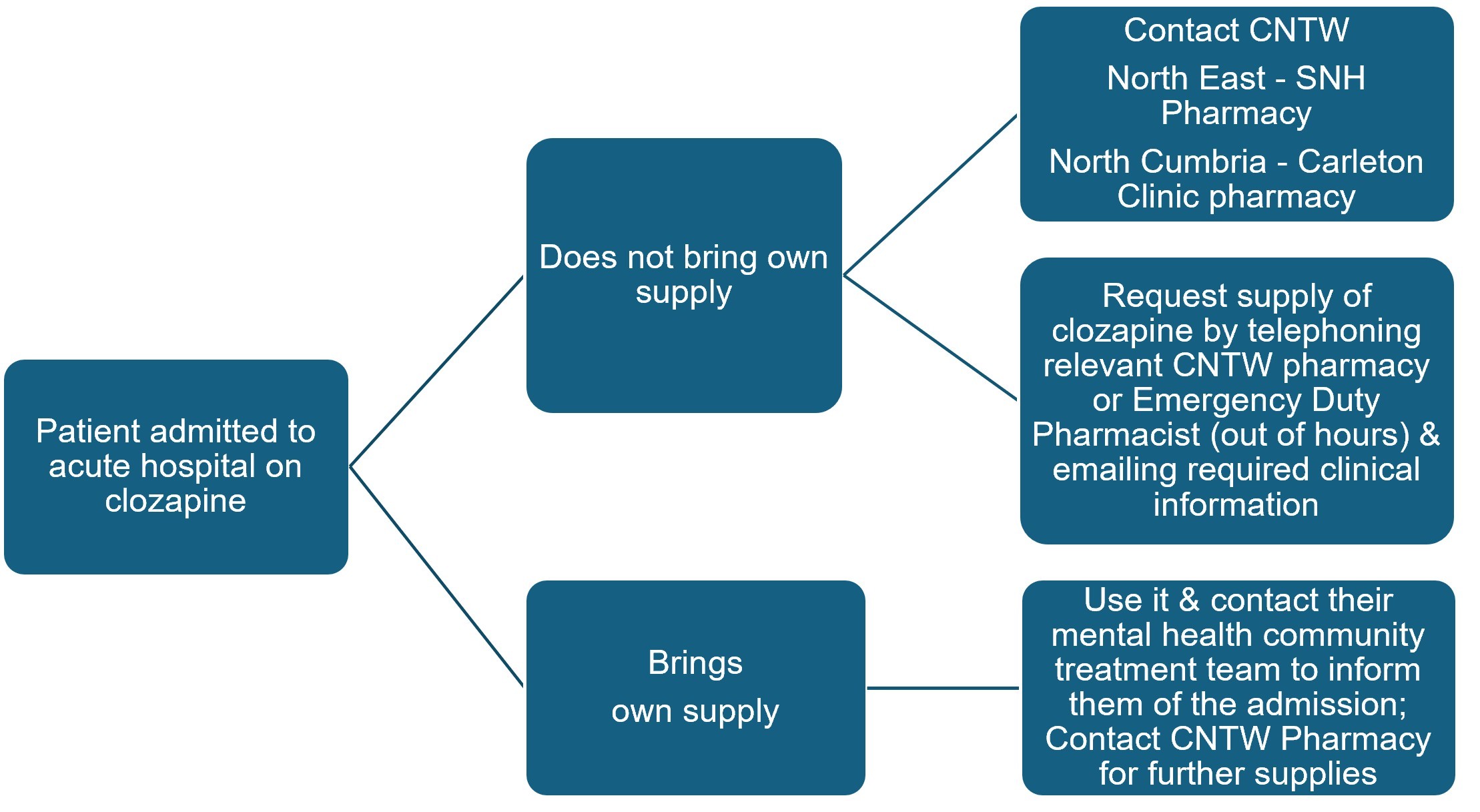
To request a clozapine supply, the following information must be provided
|
- Patient's details - Reason for admission |
- Full blood count (FBC) - Copy of Prescription chart |
- Compliance/Missed dose history (if >48hours since last dose, retitration is needed) - Smoking status - Extra: Check bowel movement for constipation |
NOTE: there are 3 brands of clozapine - Denzapine®, Zaponex® and Clozaril®.
Each manufacturer has their own monitoring system for patient registration, test results and clearance approval for supply and administration.
Clozapine is available in 3 pharmaceutical forms: tablets, suspension and orodispersible tablets (depending on the brand of clozapine).
CNTW provide Denzapine® brand of clozapine; brand switches possible on advice
Acute Trust to inform Denzapine Monitoring Service of FBC result - DMS (Tel: 0333 200 4141 – option 1)
Email details for clinical information
- North East - pharmacydispensarysnh
@CNTW.nhs.uk (8.30-17:00 Mon-Fri only) - North Cumbria - carletonclinicpharmacy
@cntw.nhs.uk (8.30-16.30 Mon-Fri only) - Out of hours (inc weekends and Bank Holidays) – as directed by Emergency Duty Pharmacist
Monday to Friday - pharmacy contact details for supply and advice
- North East – SNH Pharmacy 0191 2456606 (8:30 to 17:00)
- North Cumbria – Carleton Clinic pharmacy 01228 608269 (8:30 to 16:30)
CNTW emergency duty pharmacist contact details, out of hours Mon-Fri and weekends/Bank Holidays for supply and advice
- North Cumbria – via Carleton Clinic switchboard Tel: 01228 602000
- North East – via St Nicholas Hospital switchboard Tel: 0191 2468000
Delivery of supplies from CNTW
- Must inform CNTW pharmacy of delivery destination for clozapine supply – Acute Trust pharmacy or ward
- Acute Trust to arrange transport to collect clozapine supply from inpatient ward or CNTW pharmacy base and deliver to Acute Trust destination
Discharge from Acute Hospital
- If sufficient clozapine supply present, discharge with patient’s own specific supply of clozapine
- If further supply is needed, contact CNTW pharmacy
- Inform CNTW community treatment team of discharge and any changes to dose, who will make an appointment for the patient to attend the next CNTW clozapine monitoring clinic and arrange future supply- see https://
www. for contact detailscntw.nhs.uk/ services
Contacts for further advice
- CNTW Acute Trust Psychiatric Liaison team (PLT) via switchboard
- CNTW pharmacy - telephone numbers/email above or medinfo
@cntw.nhs.uk
 Download a Word version of Arrangements for Clozapine Supply to an Acute Hospital
Do not stop Clozapine unless clinically necessary. Maintain continuity of treatment whenever possible.
- Continue patient’s usual clozapine brand (Denzapine®, Clozaril® or Zaponex®) and dose, unless contraindicated/urgent clinical situation; contact Mental Health Trust for advice.
- CNTW patients will be prescribed the Denzapine® brand of clozapine, obtain supplies via Mental Health Trust (see document - Arrangements for Continuity of Clozapine supply to an Acute Hospital)
- Abrupt discontinuation can cause catatonia, relapse of psychosis or withdrawal symptoms
- Treatment interruptions/missed doses exceeding 48 hours requires re-titration of the dose.
- Monitor: Full Blood Count (FBC); clozapine blood drug level where appropriate; clinical complications and act urgently
Clinicians should be alert to the serious complications of Clozapine
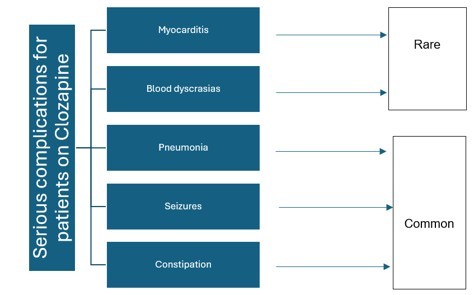
Assess patients on admission and regularly for relevant symptoms, arrange urgent assessment if serious complications are present; seek advice regarding clozapine treatment from specialist.
The presence of acute physical illness and dehydration can add to the toxicity risk.
Drug interactions of note for acute trusts - you can find a full list of drug interactions here.
|
Severe Drug Interactions with Clozapine of note– can increase toxicity/side effect risk |
||
|
Medication |
Risk |
Action |
|
Co-trimoxazole (contains trimethoprim) |
Increase risk of blood dyscrasias; agranulocytosis has been reported.
Clozapine-induced neutropenia is not dose-dependent or predictable.
|
Concurrent use contraindicated. If clinically necessary, increase FBC monitoring and plasma level monitoring whilst in use |
|
Nitrofurantoin |
Have been associated with QTc prolongation or torsade de pointes but an effect is not stablished. |
Increasing age, female sex, cardiac disease, metabolic disturbances (hypokalaemia) predisposed to QT prolongation – consider regular ECG monitoring |
Blood monitoring: to detect neutropenia or haematological changes
Full Blood Count (FBC) must be monitored at least weekly, fortnightly, or monthly, according to Denzapine Monitoring Service (DMS) monitoring status with additional monitoring where clinically indicated.
Check with Denzapine Monitoring Service (DMS) or contact CNTW pharmacy (0191 245 6606) for the patient’s current monitoring status.
The most recent FBC determines if clozapine can be supplied, administered, should be temporarily withheld or if it must be stopped – need a valid FBC ‘Green’ or ‘Amber’ result from DMS to continue.
Clozapine Blood Levels/Toxicity Risks
Clozapine blood drug level helps assess dosing, therapeutic response, adherence, drug metabolism, adverse effects/toxicity. Drug levels can increase within days of stopping smoking (not with nicotine replacement or vapes) or if constipated – can review and monitor following admission.
High blood levels of clozapine (trough level above 1mg/l) are associated with an increased risk of serious clinical complications and toxicity, including a reduced seizure threshold, sedation, tachycardia, constipation and delirium.
Obtain a clozapine blood/plasma drug level via an intravenous or capillary sample from a specialist testing service (not via the acute Trust Pathology department). Please contact CNTW pharmacy or PLT for advice.
Clozapine-induced Constipation - Advice and Treatment Guide
Clozapine can cause constipation due to gastrointestinal hypomotility, which can be severe, and can progress to obstruction, ileus, bowel rupture or necrosis. It can be fatal. Early recognition and intervention help prevent serious complications.
CONSTIPATION RED FLAGS: urgent medical assessment required if any of the following occur:
- Abdominal/bowel distension and or pain
- Overflow diarrhoea
- Absent bowel sounds.
- Symptoms of sepsis (including raised temperature/fever)
- Weight loss or significant weight gain
- Sudden onset cognitive impairment
- Persistent rectal bleeding
- Change in bowel habit for > 6 weeks alternating
- diarrhoea/constipation
- Reduced appetite and or vomiting
- Unexplained anaemia
These complications can develop within hours after symptom onset and can be fatal.
Urgent assessment and intervention are essential
Assessment of Constipation
- Assess and record bowel habit on admission, at least daily/at each review
- Intervene early and escalate urgently if any concerns, no recent bowel movements &/or obstruction suspected. Bowel function should be actively managed
- Use Bristol stool charts to track changes in frequency and consistency compared with baseline
- Proactively ask the patient about the frequency of their bowel movements, what did the poo look like, did they strain or was there pain
Patients may not be aware of constipation symptoms whilst on clozapine treatment due to:
- Reduced pain sensitivity in patients with schizophrenia
- Difficulty in communicating/ interpreting discomfort
- Clozapine’s sedative and serotonergic properties potentially reducing intestinal nociception
Key Risk factors for developing clozapine induced constipation
- Increasing age, female sex, concomitant anticholinergic medication, hypercalcaemia, diaphoresis/ dehydration (exacerbated by hypersalivation), high clozapine blood levels (consider recent smoking cessation effects), poor diet and mobility, obesity, history of bowel surgery, pre-existing constipation or gastrointestinal pathology, hypothyroidism, diabetes mellitus, Parkinson’s Disease and Multiple Sclerosis
Treatment pathway for clozapine-induced constipation
- Treatment or no bowel movement in last week - Senna 7.5mg tabs TWO tablets (15mg) at night or Macrogol ONE sachet TWICE a day
- Review in 48 hours
- If bowel movements remain less frequent than the patient’s baseline:
- Switch senna to macrogol or vice versa Consider dose increase - Review again after another 48 hours
- If still constipated, perform an abdominal and rectal examination to exclude impaction; repeat blood tests
- Review the need for any other medications which may be contributing to constipation
- If impacted: Stop laxatives and urgently discuss with gastroenterology. Enema to be prescribed.
- If not impacted: add an additional laxative, considering using up to maximum doses
- Continue regular review - If loose stools/ diarrhoea: gradually reduce laxative regimen according to symptoms. Continue to monitor, review and treat as needed.
NOTE: AVOID Bulk-forming laxatives (e.g. Fybogel®) in slow transit constipation
For further laxative guidance, please refer to the North East and North Cumbria ICB Treatment of Constipation (in Adults) Guidelines.
Further advice for healthcare professionals, patients and carers
See the Wim’s Protocol – this is a practical guide to the safe prescribing and monitoring of clozapine, provides essential information for healthcare professionals involved in clozapine prescribing and monitoring, as well as for people taking clozapine and those who support them. The protocol aims to improve awareness of the potential side effects associated with clozapine, the required monitoring arrangements, and the importance of seeking prompt medical attention should any concerns arise.
It includes the following 10 red flag symptoms may indicate the onset of potentially serious side effects of clozapine:
- Constipation (especially with nausea, vomiting and stomach pain
- Fever
- Feeling like you have flu
- Chest pain
- Shortness of breath
- Swelling of legs or ankles
- Feeling dizzy or faint
- Feeling more drowsy or sleepy than usual
- Diarrhoea or vomiting
- New or increased seizures or fits