

This leaflet explains what Flow is and how to use the Flow headset for your treatment.
Flow is a home-based treatment for depression. It uses gentle brain stimulation through a headset and an app.
Through a gentle electrical stream, the Flow headset works on a region of your brain that is linked to depression. It is safe and easy to use and has been shown to help reduce depression.
Cumbria, Northumberland, Tyne and Wear NHS Foundation Trust are testing Flow treatment within the Trust. We want to find out how well Flow helps to reduce depression in patients.
This will help us decide whether Flow should be offered to more people in the future.
We have asked you to take part because you have experience of depression.
Your views and experiences will help us understand how effective Flow is for treating depression.
The treatment usually lasts 6 to 10 weeks.
Each session lasts 30 minutes. You will use the Flow headset and app at home. Your clinician will alter the amount of stimulation sessions on your app if needed.
If you decide to take part in the Flow study, you will be asked to read information explaining how your data will be collected, used and stored.
If you are happy to take part, you will be asked to sign a consent form.
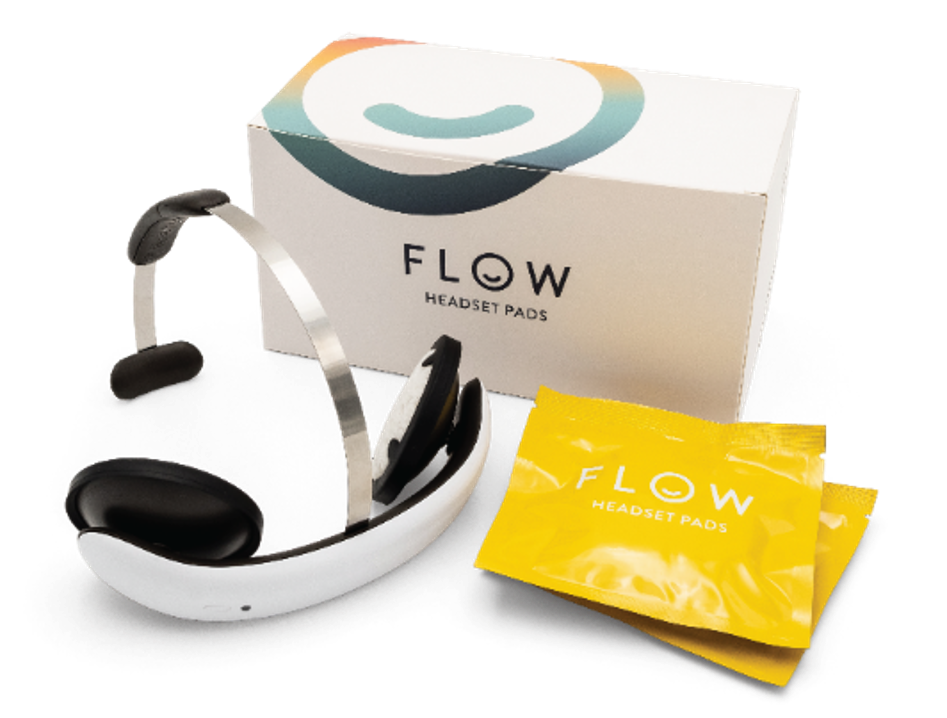
Before using the Flow headset, please ensure you read this safety information.
Do not use if:
- Pads are old or dry
- You don’t have the right pads
- You are outside or near water
- You are driving
- You are doing something dangerous
- You have had alcohol or drugs
- You are near strong magnets
Warnings:
- Do not put the headset on cuts or sore skin
- Sit down or lie down when you use the headset
- Only use the headset on your head, not on any other part of your body
- Keep the headset dry and away from the sun
- Keep the headset where small children cannot reach it
Get the App
Download the Flow app from your phone’s app store.
Open the App
Open the Flow app.
The app will ask for your email.
Tell your doctor this email so they can connect your account.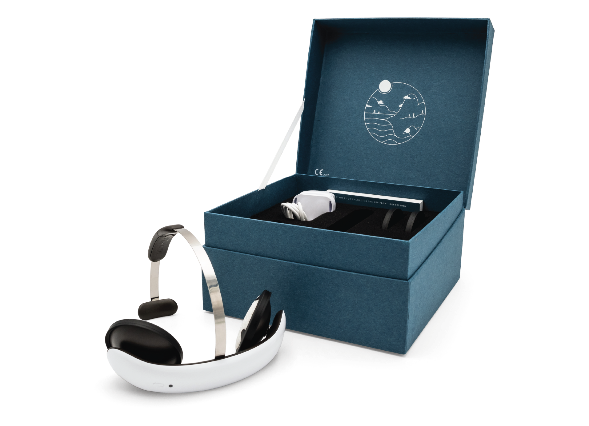
Open the box
Take the headset out of the box.
Turn on the headset
Press the button on the front of the headset. If the light blinks, the battery is okay. If there is no light, charge the headset with the charger in the box.
First time use
Your doctor will check how you feel with some questions.
Start a session
In the app, press Brain Stimulation Session. Follow the video steps:
- Tie up your hair, wash your forehead - make sure it is dry and clean.
- Connect the headset
- Open a pack of pads and attach them to the headset (use a new set of pads every time)
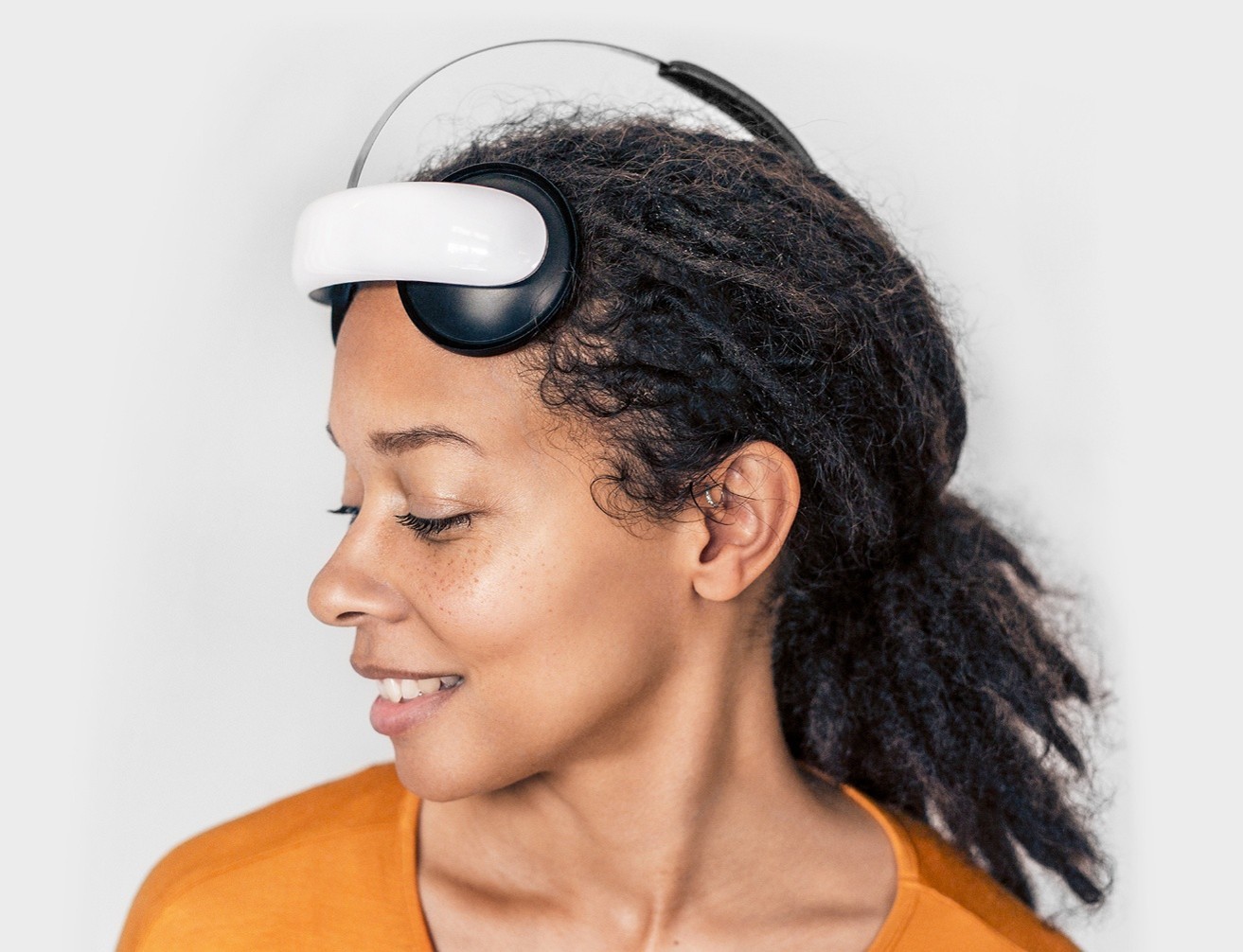
- Put the headset on your head
- Start the session
- Pause if needed
- When finished, the app will tell you and the headset will make a beeping sound
- Clean the headset. Ensure it is switched off. Use an Isopropanol (IPA) wet wipe that are provided to clean the black circles
- Throw away the pads
Important: use new pads every time.
Helpful tips
- You might feel a little sting, burn, or itch. This is normal. If it hurts too much, stop and tell your doctor.
- You might get a headache. If it is very bad or lasts more than two hours, stop and tell your doctor
- Don't give up if it doesn't work straight away, it can take several weeks to start feeling better
- You can work, meditate, read or just relax whilst using the headset, but stay seated until it’s finished.
- If the app or headset does not work, email: support
@flowneuroscience.com
Please read carefully before using your Flow headset.
How long does the Flow treatment last?
Treatment usually lasts six weeks.
Some people may need a longer period of treatment, which may last up to 8 weeks. This will usually be decided at week two or three.
You can choose to keep using the Flow headset at the end of the treatment period.
Tips for success
- Stick to the schedule
- Use the app reminders
- You can choose the days of the week you have your stimulation
- You can only use your headset once a day
- Contact your clinician if you have any problems
What happens each week
- Week 1 – 3 your activation stage. You will have five stimulation sessions per week.
- Week 4 – 6 your strengthening stage. You will have three stimulations per week.
Week 1
On your first day you will have an appointment with a clinician who will:
- Provide you with a headset
- Support you with setting up the Flow app
- Complete questionnaires with you, your clinician will complete a range of rating scales.
- Support you during your first stimulation session
From day two use your device at home four more times in the first week.
Week 2
- Complete the app questionnaire
- Use your device five times in week 2
Week 3
- Complete the app questionnaire
- Use your device five times in week 3
Week 4 and 5 – strengthening phase
- Complete the app questionnaire
- Use your device three times in weeks 4 and 5
Week 6 or later – end of treatment
- Use your device three times in week 6
- Your clinician will agree with you when your treatment ends
- You will be asked to complete the same questionnaires as to did at the start of your treatment
Here is an optional tracking table. You can choose your own days for your stimulation sessions.
| Mon | Tue | Wed | Thu | Fri | Sat | Sun | |
|---|---|---|---|---|---|---|---|
| Week 1 |
|
 |
|
|
|
||
| Week 2 | |
|
|
|
|
||
| Week 3 | |
|
|
|
|
||
| Week 4 | |
|
|
||||
| Week 5 | |
|
|
||||
| Week 6 | |
|
|
| Mon | Tue | Wed | Thu | Fri | Sat | Sun | |
|---|---|---|---|---|---|---|---|
| Week 1 | |||||||
| Week 2 | |||||||
| Week 3 | |||||||
| Week 4 | |||||||
| Week 5 | |||||||
| Week 6 |
What is the longer activation plan?
Usually, after 3 weeks, people use the headset 3 times a week.
But in this plan, you keep using it 5 times a week for longer.
Why might I need this plan?
Your doctor might choose this plan if:
- You found it hard to complete all sessions
- Your symptoms came back
- Your symptoms have been going on for a long time
- You have other health problems too
- Your symptoms are very strong
What happens each week?
Week 4 and after
- Fill in the app questions
- Keep doing 5 sessions each week until your doctor says to stop
- Your doctor will then move you to 3 sessions each week until your treatment finishes
End of treatment
- Your clinician will agree with you when your treatment ends
- You will be asked to complete the same questionnaires as to did at the start of your treatment
References
- Woodham, R.D., Selvaraj, S., Lajmi, N, et al.
Home-based transcranial direct current stimulation treatment for major depressive disorder: a fully remote phase 2 randomized sham-controlled trial.
Nature Medicine 31(1), pp87–95 (2025). - Elliot Hampsey, Michail Kalfas, Lauren Carter, et al.
A systematic review of transcranial electrical stimulation and meta-analysis of transcranial direct current stimulation RCTs in unipolar and bipolar depression.
Journal of Affective Disorders, Volume 400 (2026). - Razza LB, Luethi MS, Moffa A, et al.
Efficacy of transcranial direct current stimulation for depression: individual patient data meta-analysis. The British Journal of Psychiatry (2026).
You can talk to a staff member or use the contacts listed below. See other ways to give feedback.
Your Voice
You can use this email to tell us what you think about your care. This can be good or bad. You can also ask us to tell you what happens after you send feedback.
Email: yourvoice
Comments and complaints
If something went wrong, please tell us. This will help us improve services.
Email: complaints
Telephone: 0191 245 6672
Write to: Complaints Department, Cumbria, Northumberland, Tyne and Wear NHS Foundation Trust, St Nicholas Hospital, Gosforth, Newcastle upon Tyne, NE3 3XT.
Patient Advice and Liaison Service (PALS)
PALS offer a free, confidential service. They can help if you are worried about your care. They support patients, families and carers.
PALS North of Tyne
(services in Newcastle, North Tyneside, Northumberland and North Cumbria)
Email: pals
Telephone: 0800 032 0202
PALS South of Tyne
(services in Sunderland, Gateshead, South Tyneside and Lotus Ward, Middlesbrough)
Email: pals
Telephone: 0800 328 4397
You can get more information about this leaflet from the Patient Information Centre. This includes how the leaflet was made. We can provide this leaflet in other formats. These include Braille, audio, large print, Easy Read, British Sign Language, and other languages.
We welcome your feedback about this leaflet. You can email pic
Published by the Patient Information Centre
2026 Copyright: Cumbria, Northumberland, Tyne and Wear NHS Foundation Trust
Ref: PIC/963/0726 V1
Review date November 2026
Website: www.